Battery Energy Storage System (BESS) Market Size, Share, Trends, Growth Drivers and Forecast to 2034
Battery Energy Storage System (BESS) Market Size, Share, Trends, Growth Drivers and Forecast to 2034
Get a concise overview of the global Battery Energy Storage System (BESS) market, covering growth trends, key players, regional opportunities, technologies, and outlook through 2034.
Executive Summary: Battery Energy Storage System (BESS) Market
The global Battery Energy Storage System (BESS) market is gaining momentum as countries expand renewable energy generation, modernize electricity grids, and address growing power demand. Battery storage enables electricity to be stored during periods of surplus generation and discharged when demand increases, helping improve energy reliability, grid flexibility and renewable energy utilization.
The growing deployment of solar and wind power, increasing electricity consumption, rising demand for backup power and advancements in battery technology are creating new opportunities across the energy storage industry. Utility-scale projects are particularly important, while commercial, industrial, and residential applications are expanding as businesses and consumers seek greater control over electricity costs and reliability.
According to the International Energy Agency, approximately 108 GW of new battery storage capacity was deployed globally in 2025, representing an increase of around 40% compared with 2024. Lithium iron phosphate (LFP) batteries accounted for approximately 90% of battery storage deployments during the year. These developments highlight the growing importance of battery storage in modern electricity systems.
The market's future will depend on battery costs, project financing, grid connection capacity, government policies, safety standards, and the commercial viability of storage projects. As energy systems become increasingly dependent on variable renewable generation, Battery Energy Storage System (BESS) is expected to remain an important technology for balancing electricity supply and demand.
Battery Energy Storage System (BESS) Market Size and Forecast
The global Battery Energy Storage System market is expanding as battery technologies become increasingly integrated into electricity generation, transmission, distribution, and end-user energy management.
However, market-size estimates vary among research providers because some measure battery hardware revenue, while others include power-conversion systems, energy management software, installation, engineering, and other project components. The forecast period, base year, and treatment of related technologies can also affect reported valuations.
Consequently, a market-size estimate should always be interpreted alongside its underlying definition and methodology.
Key Market Indicators: Battery Energy Storage System (BESS) Market
- Market growth: Increasing deployment of battery storage systems across utility-scale, commercial, industrial, and residential applications.
- Technology adoption: Lithium-ion batteries remain the leading technology for stationary energy storage.
- Deployment momentum: Global annual battery storage capacity additions increased by approximately 40% in 2025.
- Major application: Utility-scale projects represent the largest portion of recent new battery storage capacity additions.
- Long-term opportunity: Renewable energy integration, grid modernization and rising electricity demand are expected to support continued investment.
The global battery storage industry added approximately 108 GW of capacity in 2025, according to the International Energy Agency. This is a deployment measure rather than a market-revenue figure, but it provides an important indicator of industry expansion.
Battery Energy Storage System (BESS) Market Growth Outlook Through 2034
The market is expected to benefit from several interconnected trends over the forecast period:
- Increasing deployment of renewable energy projects.
- Growing requirements for grid flexibility and electricity storage.
- Expansion of commercial and industrial energy management systems.
- Rising demand for reliable power infrastructure.
- Improvements in battery performance, system integration, and energy management software.
- Greater investment in electricity infrastructure and energy security.
The pace of revenue growth will depend on equipment pricing, project duration, system configuration, and the range of services included in market calculations. Installed capacity and market revenue may therefore grow at different rates.
Battery Energy Storage System (BESS) Market: Key Market Growth Drivers
1. Increasing Integration of Renewable Energy
The expansion of solar and wind power is one of the most important drivers of the Battery Energy Storage System (BESS) market. Renewable energy generation can fluctuate according to weather conditions, daylight hours, and seasonal changes, creating challenges for electricity systems that must continuously balance supply and demand.
Battery storage can capture surplus electricity during periods of high renewable generation and release it when production declines or demand increases.
For example, a solar power plant may generate more electricity during midday than the grid can immediately use. A connected battery system can store some of this electricity for use during evening peak-demand periods.
This capability can improve renewable energy utilization, reduce curtailment in suitable locations and provide greater flexibility to electricity networks.
2. Growing Demand for Grid Stability and Flexibility
Electricity grids require a continuous balance between electricity generation and consumption. Changes in demand, generation outages and fluctuations in renewable energy output can create operational challenges.
Battery energy storage systems can respond rapidly to changing grid conditions and provide services such as frequency regulation, peak-demand management, operating reserves and energy shifting.
Utilities and grid operators are increasingly evaluating battery storage as part of broader infrastructure strategies. The commercial value of these systems depends on local electricity-market rules, grid requirements, and the revenue available from different services.
3. Rising Electricity Demand from Data Centers
The expansion of cloud computing, artificial intelligence and digital infrastructure is increasing the importance of reliable electricity supply.
Data centers require dependable power for servers, cooling systems, networking equipment, and other critical infrastructure. Battery systems can provide short-duration backup, improve power quality and support energy management strategies.
However, data-center uninterruptible power supply systems and grid-scale battery storage are not identical markets. UPS systems generally provide short-duration backup, whereas grid-scale Battery Energy Storage System (BESS) installations may be designed to discharge electricity over several hours.
The growth of digital infrastructure can create opportunities for both applications, although their market sizes should be evaluated separately.
4. Improvements in Battery Technology
Advancements in battery chemistry, manufacturing, system integration, and monitoring are helping improve the performance of energy storage systems.
Lithium iron phosphate batteries have become particularly important for stationary storage because of their cost characteristics, cycle-life potential and suitability for frequent charging and discharging.
Other technologies, including nickel manganese cobalt batteries, flow batteries and sodium-ion batteries, may serve specific applications depending on energy density, duration, safety requirements, and lifecycle economics.
Continued innovation is expected to influence purchasing decisions and the competitive positioning of battery manufacturers and system integrators.
5. Increasing Focus on Energy Security
Electricity reliability has become a strategic priority for utilities, industrial facilities, commercial buildings, and remote communities.
Battery storage can support critical loads, improve resilience when configured appropriately, and reduce dependence on certain forms of backup generation.
In remote locations, battery systems combined with solar power can reduce the need for frequent fuel deliveries. In commercial and industrial facilities, storage may help manage peak demand and provide backup for selected equipment.
The economic benefits depend on the reliability requirements, electricity tariffs, local infrastructure, and the cost of alternative solutions.
6. Government Policies and Infrastructure Investment
Government initiatives, energy-transition targets, and electricity-market reforms can support battery storage deployment.
Policy measures may include investment incentives, storage procurement programs, renewable energy integration requirements and mechanisms that compensate storage operators for providing grid services.
However, regulatory frameworks differ considerably across countries. Project developers must evaluate applicable incentives, interconnection rules, permitting requirements, domestic manufacturing policies, and safety standards before committing capital.
Market Restraints and Challenges
Despite its growth potential, the Battery Energy Storage System (BESS) market faces several challenges that can affect project development and profitability.
1. High Initial Investment
Battery storage projects require investment in battery cells, power-conversion equipment, enclosures, thermal management, safety systems, installation, and grid interconnection.
Although declining equipment prices can improve project economics, total installed costs remain dependent on project size, storage duration, location, and technical requirements.
High upfront expenditure can make financing difficult when future electricity prices or revenue streams are uncertain.
2. Battery Degradation and Replacement Costs
Battery performance changes over time as a result of operating conditions, temperature, charge-discharge cycles, and other factors.
Degradation can reduce usable energy capacity and affect the amount of electricity a system can deliver over its operating life. Project owners must consider warranty conditions, maintenance requirements, augmentation, and potential replacement costs when evaluating long-term returns.
3. Fire Safety and Thermal Management
Battery systems require appropriate engineering and safety controls to manage the risk of overheating, thermal runaway and fire.
Manufacturers and operators must consider battery chemistry, system design, temperature monitoring, ventilation, fire detection, suppression, and emergency response procedures.
Compliance with applicable standards and careful site planning are essential to reliable operation.
4. Grid Connection and Permitting Delays
Battery storage projects may face delays related to interconnection studies, transmission capacity, permitting, land availability, and regulatory approvals.
These delays can increase development costs and postpone revenue generation, even when equipment procurement is complete.
Improved grid planning and streamlined approval processes can help reduce these barriers in suitable markets.
5. Uncertain Project Revenue
Battery storage systems may earn revenue through electricity arbitrage, capacity payments, grid services, and contractual arrangements.
However, these revenue sources are not guaranteed. Electricity price differences may narrow as additional storage systems enter the market, while ancillary-service prices and regulations can change.
Project developers must evaluate multiple revenue scenarios rather than relying on a single source of income.
Battery Energy Storage System (BESS) Market Segmentation
The Battery Energy Storage System market can be segmented by battery type, connection type, ownership, application, technology integration, and region.
Battery Energy Storage System (BESS) Market By Battery Type
Lithium-Ion Batteries
Lithium-ion batteries are the leading technology for stationary battery storage. LFP batteries are widely used in utility-scale and commercial storage, while NMC batteries may be selected for applications where energy density is an important consideration.
Their adoption is supported by manufacturing scale, established supply chains and continued improvements in system integration.
Lead-Acid Batteries
Lead-acid batteries are an established technology used in backup power and selected stationary applications. They can offer relatively low upfront costs, although their energy density, weight and cycle-life characteristics may limit suitability for some frequently cycled storage projects.
Flow Batteries
Flow batteries store energy in liquid electrolytes and can offer advantages for certain longer-duration applications. Their commercial suitability depends on system efficiency, equipment costs, operating requirements, and the characteristics of the target project.
Sodium-Sulfur and Other Emerging Batteries
Alternative battery chemistries may offer opportunities for specialized stationary storage applications. Their adoption will depend on commercial maturity, safety, lifecycle cost, and performance under actual operating conditions.
Battery Energy Storage System (BESS) Market By Connection Type
On-Grid Systems
On-grid battery storage systems are connected to the electricity network. They can support renewable energy integration, peak-demand management, grid services, and energy arbitrage.
Off-Grid Systems
Off-grid systems operate independently of the main electricity network. They are relevant to remote communities, isolated industrial facilities, islands and locations where grid access is limited or unreliable.
Battery Energy Storage System (BESS) Market By Ownership
Utility-Owned Systems
Utilities own and operate battery storage assets to support grid planning, flexibility, and electricity-system reliability.
Customer-Owned Systems
Businesses, industrial facilities and residential consumers purchase and operate systems to manage electricity costs, support backup requirements, or improve renewable energy utilization.
Third-Party-Owned Systems
Developers, investors or energy-service providers own the assets and supply storage services through contracts, leasing arrangements, or other commercial models.
Battery Energy Storage System (BESS) Market By Application
Utility-Scale Storage
Utility-scale systems support grid balancing, energy shifting, renewable integration, and other large-scale electricity applications. They are an important segment of the market because a single project can contribute substantial power and energy capacity.
Commercial and Industrial Storage
Commercial and industrial systems help businesses manage peak demand, improve power reliability, and optimize electricity consumption. Applications include factories, warehouses, offices, retail facilities, and industrial campuses.
Residential Storage
Residential battery systems are commonly paired with rooftop solar installations. They can increase solar self-consumption, provide backup power, and help households manage time-of-use electricity tariffs where applicable.
Microgrids and Remote Power
Battery storage is an important component of microgrids that combine local generation, storage, and electricity management. These systems can improve energy access and reliability in remote or infrastructure-constrained locations.
Battery Energy Storage System (BESS) Market By Technology Integration
Standalone Systems: Battery installations operating as independent storage assets.
Hybrid Power Systems: Storage integrated with solar, wind or other generation technologies.
Microgrids: Local electricity systems combining generation, storage and distribution.
Virtual Power Plants: Coordinated networks of distributed energy resources managed through software.
The commercial potential of each configuration depends on system requirements, market access, available revenue streams, and local regulations.
Battery Energy Storage System (BESS) Industry: Regional Market Analysis
Asia-Pacific
Asia-Pacific is an important region for battery storage manufacturing and deployment. China has a substantial battery supply chain and continues to play a major role in global storage additions.
India presents opportunities linked to renewable energy deployment, rising electricity demand, and grid flexibility requirements. Australia is also an important market because of renewable integration and electricity-system needs.
Japan and South Korea offer additional opportunities associated with energy security, technology development, and electricity infrastructure.
Regional growth will depend on procurement programs, grid connection capacity, financing conditions, and the evolution of electricity-market regulations.
North America
North America is a significant market for utility-scale battery storage and integrated energy management solutions.
In the United States, storage deployment is supported by renewable energy integration, grid modernization, and demand for flexible electricity infrastructure. Commercial and industrial customers are also evaluating batteries for peak-demand management and backup applications.
Canada presents opportunities related to grid reliability, renewable generation, and remote power systems.
Policy changes, interconnection queues, equipment sourcing, and project economics remain important considerations for market participants.
Europe
Europe's battery storage market is influenced by renewable energy expansion, electricity-market flexibility, energy security, and grid modernization.
Countries including Germany, Italy and the United Kingdom are relevant markets for utility-scale and distributed storage. However, deployment conditions vary according to electricity pricing, network constraints, permitting, and national market structures.
Battery storage can help improve the utilization of renewable electricity and provide flexibility in power systems with increasing shares of variable generation.
Middle East and Africa
The Middle East and Africa offer opportunities related to solar-plus-storage projects, electricity reliability, and energy infrastructure development.
Large renewable energy projects can create demand for utility-scale storage, while remote communities and industrial facilities may benefit from localized energy systems.
Saudi Arabia, the United Arab Emirates and South Africa are among the markets worth monitoring. Investment decisions must account for procurement frameworks, financing, grid infrastructure, and project-specific requirements.
Latin America
Latin America presents opportunities associated with solar and wind expansion, electricity-system flexibility, and transmission constraints.
Chile and Brazil are relevant markets to monitor, although project economics and deployment timelines differ across countries.
The development of battery storage will depend on electricity-market regulations, financing availability, renewable energy contracts, and the ability to connect projects to the grid.
Competitive Landscape and Major Companies in Battery Energy Storage System (BESS) Market
The Battery Energy Storage System (BESS) market includes battery manufacturers, system integrators, power-electronics providers, software companies, and project developers. Competition is based on product performance, system cost, safety, reliability, warranties, project execution, and service capabilities.
Tesla
Tesla participates in the market through its utility-scale Megapack storage systems and energy-management software. Its integrated hardware and software offerings are relevant to grid-scale projects and energy optimization.
Sungrow
Sungrow supplies power-conversion equipment and integrated energy storage solutions. Its experience in power electronics and renewable energy infrastructure supports its participation in the global storage market.
BYD
BYD operates across battery manufacturing, electric vehicles, and stationary energy storage. Its battery manufacturing capabilities and storage-system portfolio position it as an important participant in the industry.
CATL
CATL is a major battery manufacturer supplying products for multiple applications, including stationary energy storage. Battery-cell manufacturing scale and technology development are important aspects of its competitive position.
Fluence Energy
Fluence Energy provides integrated energy storage solutions, digital software, and services. Its market position is associated with system integration, energy optimization and project lifecycle support.
Huawei
Huawei participates through digital power and energy-storage solutions, combining power electronics and digital management capabilities.
Other Market Participants
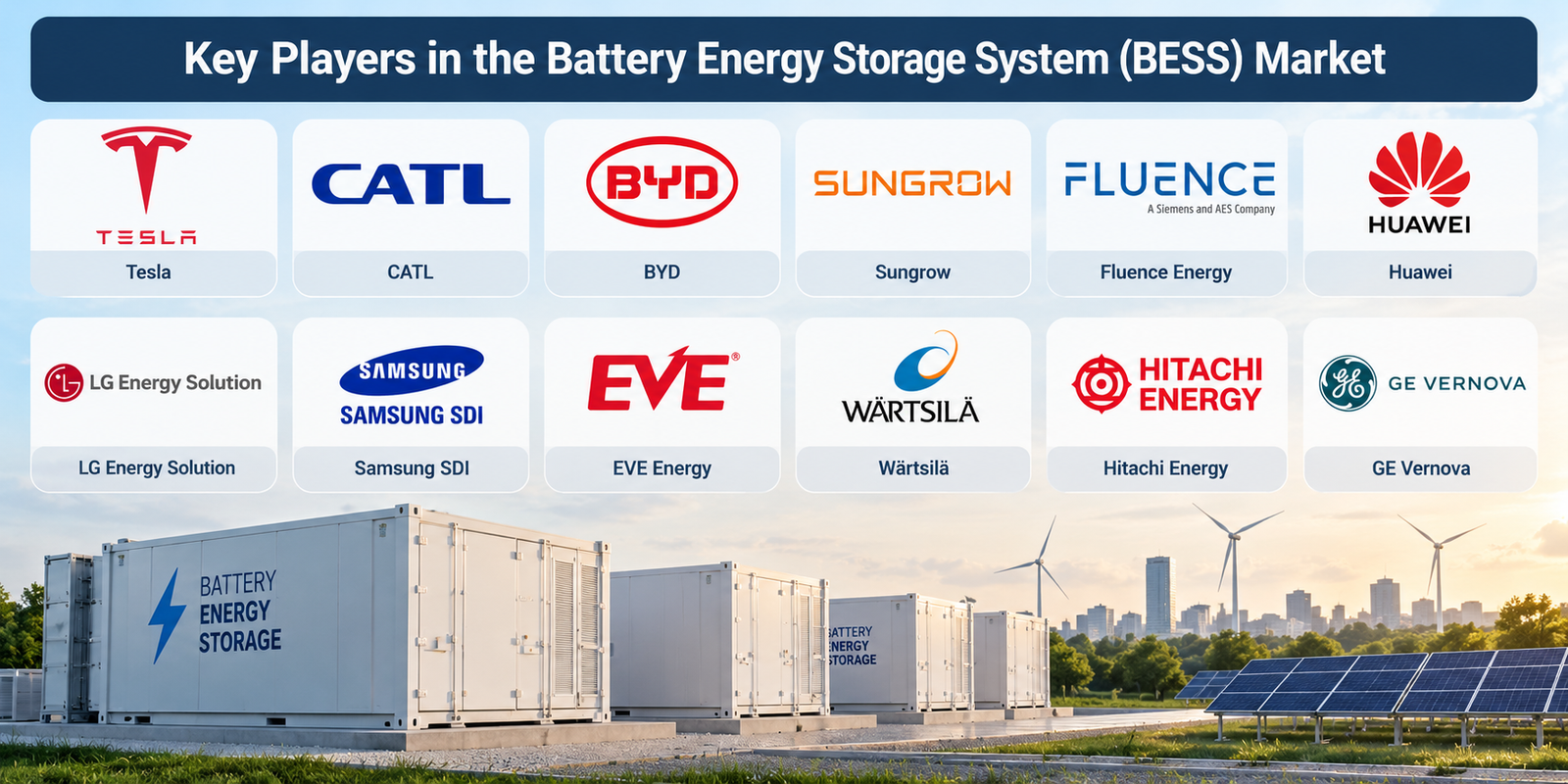
Other companies active across different parts of the battery storage value chain include EVE Energy, LG Energy Solution, Samsung SDI, Wärtsilä, Hitachi Energy, and GE Vernova.
The competitive landscape differs by product category and geography. Battery-cell shipments, integrated system shipments, installed capacity and total market revenue are distinct measures, so supplier rankings should be interpreted using the relevant metric.
Emerging Trends in the Battery Energy Storage System (BESS) Market
Increasing Adoption of LFP Batteries
LFP batteries have become important for stationary energy storage because of their cost characteristics and suitability for frequent cycling. Continued manufacturing expansion and system integration improvements may influence their adoption across utility-scale and commercial applications.
Longer-Duration Energy Storage
Some electricity markets increasingly require batteries capable of delivering energy over longer periods. This creates opportunities for longer-duration lithium-ion installations and alternative storage technologies where lifecycle economics are competitive.
AI-Enabled Energy Management
Advanced software can help operators forecast electricity prices, renewable output and demand, then optimize charging and discharging schedules.
The potential benefits include improved asset utilization and better revenue optimization, although results depend on market access, forecasting accuracy and operating conditions.
Modular and Integrated Storage Systems
Containerized and modular systems can simplify transportation, installation, and capacity expansion. Suppliers are increasingly competing on integration quality, safety, reliability and total installed cost.
Battery Recycling and Lifecycle Management
As installed battery capacity increases, end-of-life management and material recovery are becoming more important.
Recycling and reuse can help recover valuable materials and reduce waste, although commercial viability depends on collection systems, battery condition, processing technology and material prices.
Opportunities for Businesses and Investors
The Battery Energy Storage System (BESS) market offers opportunities across several parts of the value chain.
Battery Manufacturing: Suppliers can serve system integrators and project developers, although success requires capital investment, manufacturing scale and effective cost management.
System Integration: Companies can combine batteries, inverters, controls, safety systems and software into complete solutions for utilities and end users.
Energy Management Software: Digital platforms can improve dispatch decisions, coordinate distributed assets and help operators manage electricity-market participation.
Safety and Thermal Management: Monitoring, cooling, detection and safety technologies are essential components of reliable storage installations.
Operations and Maintenance: Monitoring, servicing, warranty management, and performance optimization can generate recurring service opportunities.
Recycling and Second-Life Applications: Battery recovery and reuse may create opportunities as storage assets age, subject to technical suitability and commercial economics.
Project Development: Developers can identify suitable sites, secure grid connections, arrange financing, and structure commercial agreements for storage installations.
The attractiveness of each opportunity depends on competition, capital requirements, regulatory conditions, customer demand, and project-level profitability.
Future Outlook Through 2034
The Battery Energy Storage System market is positioned for continued development as electricity systems require greater flexibility and renewable energy becomes a more important part of power generation.
Utility-scale installations are expected to remain central to deployment, while commercial, industrial, and residential systems may expand in markets where storage can deliver measurable savings or reliability benefits.
Technology development is likely to focus on battery cost, system safety, efficiency, useful life, longer-duration operation, and software-enabled optimization. Manufacturers and integrators will continue competing on product reliability, project execution, supply-chain capabilities, and total lifecycle cost.
Nevertheless, the pace of expansion will vary across regions. Financing conditions, electricity-market rules, grid connection delays, and equipment prices will influence the number of projects that can proceed.
Overall, battery storage is expected to remain an important part of modern electricity infrastructure. Companies that combine competitive technology, reliable systems, strong project execution, and effective lifecycle services will be better positioned to respond to evolving market requirements.
Research Methodology
A comprehensive assessment of the Battery Energy Storage System (BESS) market should consider historical market performance, installed capacity, annual deployments, battery technology adoption, application demand, and regional investment trends.
Market-size estimates should be evaluated according to their defined scope, base year, forecast period, and treatment of equipment and services. Revenue estimates should not be combined directly with capacity statistics measured in GW or GWh.
Competitive analysis should assess product portfolios, system shipments, installed projects, geographic presence, technology capabilities, and publicly disclosed company developments.
Forecasts should also account for battery costs, grid infrastructure investment, regulatory conditions, project financing, safety requirements, and changes in electricity-market economics.
Using consistent definitions and multiple independent indicators helps produce a more reliable assessment of the global battery energy storage industry.
-
Executive Summary
-
BESS Market Size and Forecast
-
Key Market Drivers
-
Market Restraints and Challenges
-
Market Segmentation
-
Regional Market Analysis
-
Competitive Landscape
-
Emerging Market Trends
-
Business and Investment Opportunities
-
Future Outlook Through 2034
-
Research Methodology
Key Market Drivers
-
Rapid expansion of solar and wind energy
-
Increasing need for grid stability and flexibility
-
Rising electricity demand from data centers
-
Advancements in battery technology
-
Growing focus on energy security and backup power
-
Government incentives and energy-transition policies
-
Increasing investment in grid modernization
-
Growing commercial and industrial demand for energy storage
By Battery Type
-
Lithium-Ion Batteries
-
Lead-Acid Batteries
-
Flow Batteries
-
Sodium-Sulfur and Other Emerging Batteries
By Connection Type
-
On-Grid Systems
-
Off-Grid Systems
By Ownership
-
Utility-Owned Systems
-
Customer-Owned Systems
-
Third-Party-Owned Systems
By Application
-
Utility-Scale Storage
-
Commercial and Industrial Storage
-
Residential Storage
-
Microgrids and Remote Power
By Technology Integration
-
Standalone Battery Storage
-
Hybrid Power Systems
-
Microgrids
-
Virtual Power Plants
By Region
-
North America
-
Europe
-
Asia-Pacific
-
Middle East and Africa
-
Latin America
By Companies
Key Players in the BESS Market
- Tesla
- CATL
- BYD
- Sungrow
- Fluence Energy
- Huawei
- LG Energy Solution
- Samsung SDI
- EVE Energy
- Wärtsilä
- Hitachi Energy
- GE Vernova
The Battery Energy Storage System market assessment is based on a structured analysis of market trends, deployment activity, technology adoption, regional developments, competitive positioning, and industry growth drivers.
The research evaluates:
-
Historical market performance and deployment trends
-
Battery storage capacity additions
-
Technology adoption across different battery types
-
Utility-scale, commercial, industrial, and residential demand
-
Regional investment and infrastructure developments
-
Competitive positioning of major market participants
-
Regulatory, financing, safety, and grid-related factors
Market estimates are evaluated according to their defined scope, base year, forecast period, and inclusion of equipment, software, engineering, installation, and related services.
Capacity figures measured in GW or GWh are considered separately from market revenue figures to avoid direct comparison between different measurement methodologies.
Multiple industry indicators and market factors are considered to provide a balanced assessment of the global Battery Energy Storage System market.
Frequently Asked Questions
What is a Battery Energy Storage System (BESS)?
What is driving the growth of the Battery Energy Storage System (BESS) Market?
Which battery technology is widely used in Battery Energy Storage System (BESS) Market?
What are the main applications of battery energy storage systems?
Which region is important in the global BESS market?
Who are the major Battery Energy Storage System BESS companies?
What challenges affect Battery Energy Storage System (BESS) market growth?
What is the future outlook for the BESS market?
Purchase this report
Choose the licence that fits your team
Need a sample, customisation or a quote?
Talk to an analyst